
Automation is changing the way individuals and businesses manage daily digital work. processes, applications such as ChatGPT have been tested in terms of efficiency. A lot of individuals seek ChatGPT automation with the hopes that it will be similar to older background software. However, in practice, ChatGPT has a different operating model that should be considered prior to its application into automation.
What Is ChatGPT Automation?
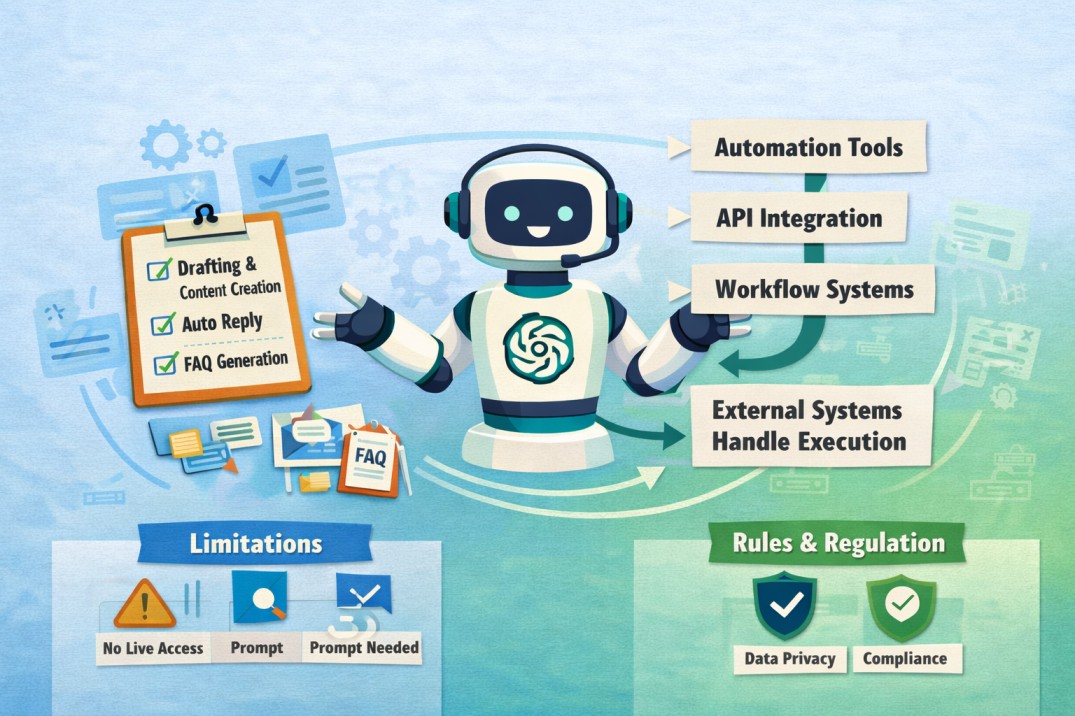
ChatGPT automation ChatGPT can be used as an engine to support repetitive or structured tasks. Users can use ChatGPT to produce responses, compose texts, analyze text, or plan instead of doing the same thing over and over again using their own hands. Nevertheless, ChatGPT does not automatically do things by itself.
It is only when ChatGPT is linked to other systems, either workflow software, API, or software platform, that automation occurs. The systems initiate requests, feed data to ChatGPT, get the response, and do so. The work of ChatGPT is not process-oriented, but rather language translation and language creation.
Understanding ChatGPT Background Tasks
ChatGPT background tasks are a topic of many questions since users expect this system to be able to work silently or with continuous use. ChatGPT is not a background application. It operates on a prompt-based system, that is, it only responds to a request being made.
Background task behavior may be facilitated as follows:
- Scheduled automation tools
- Backend scripts or applications
- Third-party integrations
As an example, an organization can use the scheduler to send customer requests to ChatGPT at specified schedules. ChatGPT does the responses, and the storage or delivery is done by the automation tool. The background activity is operated by the external system and not ChatGPT.
Common Use Cases for ChatGPT Automation
Despite its limitations, ChatGPT automation is widely used for language-based tasks, such as:
- Composing responses to customers.
- Creating blog summaries and outlines.
- Developing product descriptions and frequently asked questions.
- Helping in documentation and reports.
- Assistance with the generation of ideas and key words.
These functions save time and enhance unanimity particularly when matched with automation platforms that carry out execution.
ChatGPT Automation Limitations
Understanding ChatGPT automation limitations is essential for realistic expectations. ChatGPT cannot:
- Monitor systems or events continuously
- Execute commands or trigger actions independently
- Access real-time databases without integration
- Store long-term memory across sessions automatically
Another key limitation is accuracy. ChatGPT relies entirely on the information provided in prompts. Incorrect or unclear input can result in misleading output, which means human review is always necessary.
Rules and Regulations to Consider
In case of responsible use of ChatGPT automation, it is necessary to know the rules and regulations. Care should be taken not to share sensitive information that might include personal information, financial information, or confidential records without making adequate protective measures. Protecting data should also be observed at all times when automating workflows. Transparency is valued in communication with the customers.
In case automated responses are being worked with, then the businesses are supposed to make sure that they are in line with the policies of the platform and with the expectations of the users. Automated content is also to be verified in terms of originality and relevance. Automation is only supposed to support decision-making, as opposed to accountability. Quality, trust, and compliance are enforced by human supervision.
Best Practices for Effective Automation
To get the most value from ChatGPT background tasks, users should:
- Use clear, specific prompts
- Review outputs before publishing or sending
- Avoid using it for critical or sensitive decisions
ChatGPT automation can be very beneficial when it is applied in the right way, and human control remains. It is an intelligent assistant that can be integrated into a well-organized system and assist workflows instead of being an independent one.
Conclusion
The ChatGPT automation operates with the help of aiding the users in the language-based tasks and structured workflow, whereas the outside-help tools handle the execution and scheduling. It does not do background work and does not act on its own. The background tasks of ChatGPT and the limitations of ChatGPT automation assist users in using it responsibly. ChatGPT automation enhances productivity and removes redundant work when properly regulated and controlled, as well as helps to work more efficiently when it does not substitute human control and supervision.